One Name, Several Geological Histories
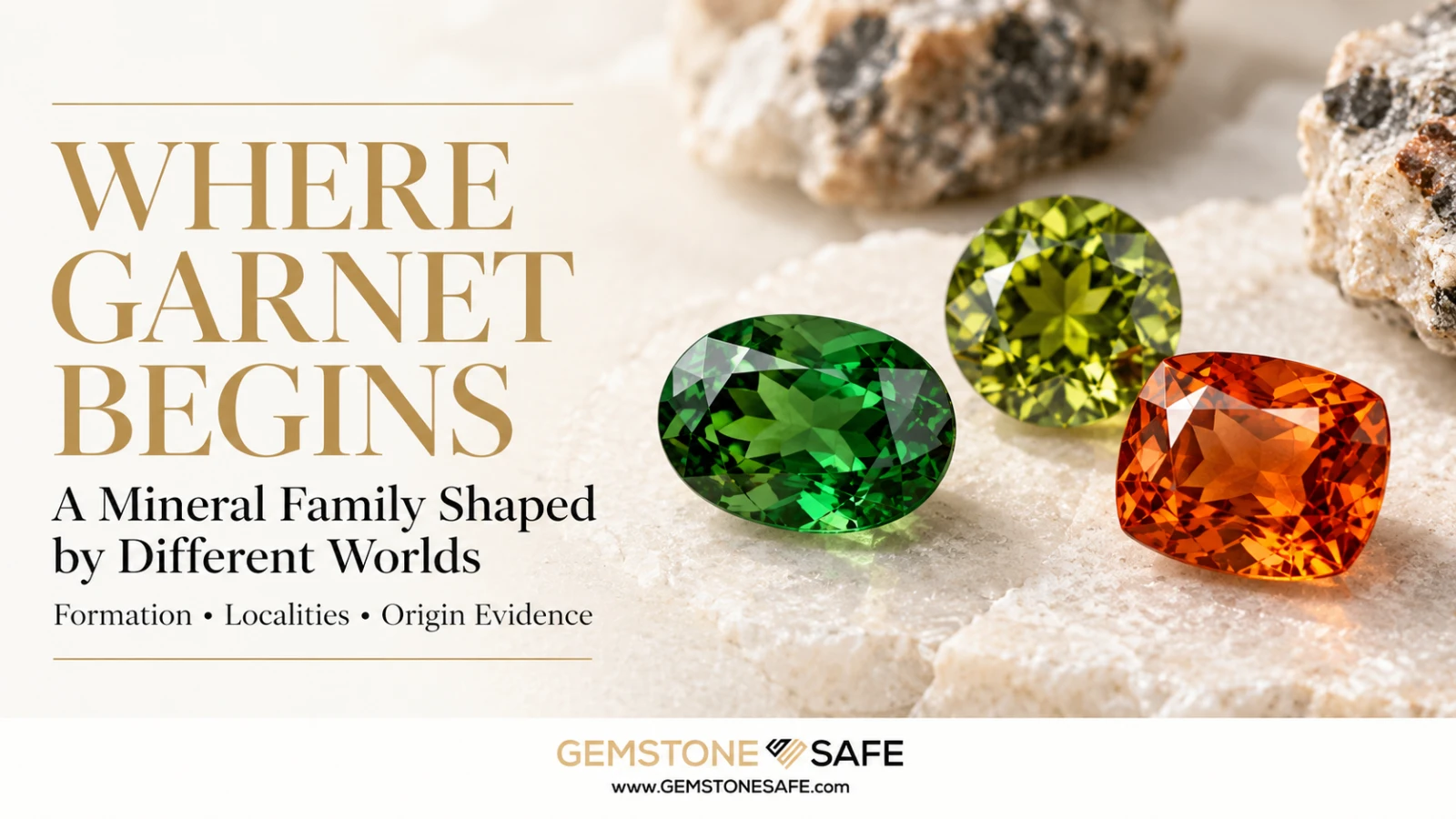
A green tsavorite, an orange spessartine, and a red rhodolite belong to the garnet family, but their shared name does not imply a shared geological origin. Garnets are related minerals with different chemical compositions, and many natural specimens contain components of more than one species.
That diversity changes how we should discuss their sources. “Where is garnet found?” is a useful opening question; “Which garnet, in which geological setting?” is more informative. It directs attention to the particular mineral, its host rocks, and the processes responsible for its growth.
For buyers and collectors, this distinction also improves the reading of an origin claim. The mineral identity, location of recovery, and documented history of a gemstone are separate pieces of information. Each deserves evidence appropriate to the question it answers.
Composition Comes Before the Country Name
The common silicate gem garnets follow the general formula X₃Y₂(SiO₄)₃. Different elements occupy the X and Y positions in the structure. In pyrope, almandine, and spessartine, magnesium, iron, and manganese respectively distinguish the ideal end-member compositions, while aluminum occupies the Y position. Natural stones often depart from those ideal compositions through substitution.
A “solid solution” describes this incorporation of different components within a crystal structure; it does not mean separate pieces have been physically mixed together. Understanding that point helps explain why natural garnets need not fall neatly into simple color categories.
Rhodolite garnet is associated with pyrope almandine compositions; tsavorite is green grossular, and demantoid is green andradite. These identities are useful starting points for research, but none is a complete geographic address. A laboratory may establish what a stone is with considerably more confidence than where it was mined. A seller should preserve that distinction when turning technical results into a product description.
Metamorphism: Garnet Growing as Rocks Change
Metamorphism transforms existing rock through heat, pressure, and chemical reactions. Minerals grow or recrystallize as the rock adjusts to new conditions. Garnet is a familiar constituent of metamorphic rocks, including schists, but gem-quality growth requires a favorable combination of chemistry and preservation.
Tsavorite illustrates a more specific setting. Research summarized by GIA links East African tsavorite to metamorphosed sedimentary sequences containing graphitic gneiss and schist, calc-silicate rocks, marble, and associated units. Its geological history is connected with the Pan-African mountain-building events, and fluids may have helped redistribute the ingredients involved in growth.
This explanation is more accurate than saying that pressure simply turns ordinary rock into a gemstone. Heat and pressure influence reactions, but the necessary elements must also be available in a suitable environment. It also explains why finding garnet-bearing rock does not guarantee a deposit of transparent cutting material. Geological occurrence and commercial gem production are different propositions.
Spessartine and the Pegmatite Environment
Some garnets grow in igneous settings. Granitic pegmatites are unusually coarse-grained rocks associated with magmatic processes; their development can concentrate ingredients and create conditions favorable for large mineral crystals. Their formation histories vary, so one simplified model should not be applied indiscriminately to every deposit.
Spessartine from the Ramona district of southern California offers a documented example. GIA’s study describes production from pegmatites near the Little Three mine and reports orange to yellow-orange material dominated by the spessartine component. The examined stones showed manganese-related absorption features, with a smaller iron contribution.
That is a connection between geological setting, chemical composition, and optical behavior. It does not establish that every orange garnet is pegmatitic or that all spessartines formed under identical conditions. When a source description names a rock type, ask whether it refers to the specific deposit under discussion. A mineral can occur in more than one setting, and a familiar example is not a universal rule.
Demantoid: Two Routes to Green Andradite
Demantoid makes the relationship between mineral identity and geological diversity particularly clear. Published research distinguishes serpentinite-related and skarn-related occurrences. Serpentinite forms through alteration of ultramafic rocks, which are rich in magnesium and iron. Classic demantoid localities in the Russian Urals and Italy’s Val Malenco are associated with this broad setting.
The Antetezambato deposit in northern Madagascar provides a contrasting example. Research relates its demantoid and topazolite to skarn formation involving magmatic intrusions and calcareous sediments. Skarn develops through reactions and chemical exchange, commonly involving heated fluids and carbonate-rich rocks near an intrusion.
The contrast helps explain why demantoids from different geological environments can contain different inclusion assemblages. It also shows why similar green appearance is insufficient to establish a locality. For a collector, these differences can make two demantoids interesting for different reasons. The geological story should add information to the specimen rather than become a shortcut for ranking every stone from one country above every stone from another.
From the Original Rock to a Secondary Deposit
A gemstone can be recovered from the rock in which it formed or from material produced by that rock’s weathering and erosion. In a secondary deposit, the crystal has been released and redistributed. Alluvial deposits involve transport and concentration by flowing water. Sri Lanka offers an important example of gemstone recovery from secondary gravels. GIA’s field study describes widespread alluvial deposits, locally known as illam, within the island’s gem industry.
Finding a garnet in such gravel identifies its recovery environment; it does not mean the crystal grew in the river. Its original host rock may have been weathered away or may lie elsewhere in the drainage system. Keep this distinction in mind when reading descriptions of “river-mined” or “alluvial” gems. These phrases describe part of a geological journey. They do not independently establish superior color, treatment status, or a more complete commercial history.
A Source Map Organized by Garnet Type
Garnet geography becomes easier to understand when individual varieties are separated. The examples below are documented localities or historic associations, not a current production ranking or a complete inventory of deposits.
|
Garnet type |
Selected documented sources |
What the association tells us |
|
Tsavorite |
Kenya and Tanzania |
Important East African sources of green grossular |
|
Demantoid |
Russia, Italy, Namibia, Madagascar |
A variety found in different geological settings |
|
Spessartine |
Namibia, Nigeria, United States |
Multiple sources of orange garnet, including documented pegmatitic material in California |
|
Rhodolite |
Tanzania and Sri Lanka |
Purplish red garnet occurs in more than one producing region |
|
Hessonite |
Sri Lanka and Tanzania |
Grossular variety represented by material from different sources |
|
Bohemian pyrope |
Czech Republic |
A historic association with red garnet jewelry |
The location attached to a reference specimen is valuable research information. Matching its appearance is not equivalent to proving that a newly examined stone came from the same place. Nor should an older publication be read as a statement that a mine is operating today. Deposit discovery, historic output, present extraction, and material circulating in trade are distinct matters.
Inclusions Are Clues:
The interior of a garnet can preserve evidence of growth, trapped material, and later events. GIA’s Ramona spessartine study records features including two-phase inclusions in partially healed fractures, negative crystals, and growth patterns. A negative crystal is a cavity whose form reflects the surrounding crystal structure. Demantoid’s horsetail inclusions provide a familiar caution. GIA notes that these occur in material from Iran and Italy as well as Russia; their presence alone does not guarantee Russian origin.
An inclusion photograph is therefore best read as an observation about a studied specimen. Its interpretation depends on mineral identification, associated features, and the broader evidence. When a gemstone is unusually clean, the absence of conspicuous inclusions need not mean an absence of quality. It may simply leave fewer microscopic clues available for geographic interpretation. Conversely, an interesting inclusion can enrich a specimen’s scientific appeal without establishing a mine name.
What Laboratory Analysis Can Establish
Origin research combines microscopy with chemical and spectroscopic information and comparisons against documented reference material. Raman spectroscopy can identify many enclosed minerals. Absorption spectroscopy helps investigate color-producing mechanisms. Trace-element measurements can reveal chemical patterns useful for comparing samples. These are complementary tools, rather than instruments that directly read a country name from a gem. The research question matters. Establishing a garnet’s composition is different from assigning a geographic origin. The usefulness of a chemical pattern for the second task depends on reference coverage and how distinctly the possible sources separate.
Report services must also be checked for the particular material. GIA’s published service list includes demantoid among gems eligible for an Identification & Origin Report; it does not extend that listing to all garnet varieties. Its identification reports address material identity and detectable treatments. Before commissioning testing, explain which claim needs assessment. Read the final wording carefully, including limitations. A report should not be described as confirming a mine or country when it provides only identification.
Provenance Extends Beyond Geological Origin
A geographic origin opinion and a documented ownership or supply history address different questions. A report may assess where a gem is consistent with having formed, while invoices, rough-sale records, and cutting documentation may connect stages in its commercial journey.
SSEF’s GemTrack illustrates a particular form of scientific tracking: comparing characteristics before and after cutting to link a polished stone with an examined rough stone. SSEF explicitly distinguishes this from establishing a mine of origin or determining how and when the gem was mined. This example explains the distinction; suitability of any tracking service for a particular garnet requires confirmation.
For a meaningful provenance file, ask which stages are supported and which remain unknown. Keep records connected to the individual stone wherever possible. A supplier’s general relationship with a producing country is not, by itself, a documented chain for every gemstone sold.
Put Origin in Proportion When Considering Value
Garnet quality must be assessed by type. GIA notes that larger fine tsavorites and demantoids are relatively scarce, while larger almandines are more readily available. Color, clarity, cutting, and size remain central to evaluating the individual gem.
If origin matters to your collecting interest, ask how confidently it is supported and what you are being asked to pay for that distinction. Compare stones of similar variety and quality rather than assuming a fixed premium for a country name.
A historic locality can enrich a collection, but its reputation cannot correct an unattractive cut or establish an unsupported scarcity claim. Likewise, a newly reported source should not automatically be described as rare, superior, or a future investment opportunity. For your own records, separate the gemstone’s observed qualities, laboratory findings, seller disclosures, and personal reasons for choosing it. That makes the decision easier to review and the story easier to pass on accurately.
Discuss the Origin That Matters to You
Garnet’s geological diversity is part of its appeal: related minerals can record very different histories of rock transformation, crystallization, fluid activity, and erosion. Understanding those differences makes a source description more informative.
Contact GEMSTONESAFE to discuss a preferred garnet variety, locality interest, or sourcing requirement. Share the appearance you enjoy and the supporting documentation you would like to review, so the conversation can begin with both the gemstone and the evidence behind its story.