Where a Ruby Comes From and Why the Answer Matters
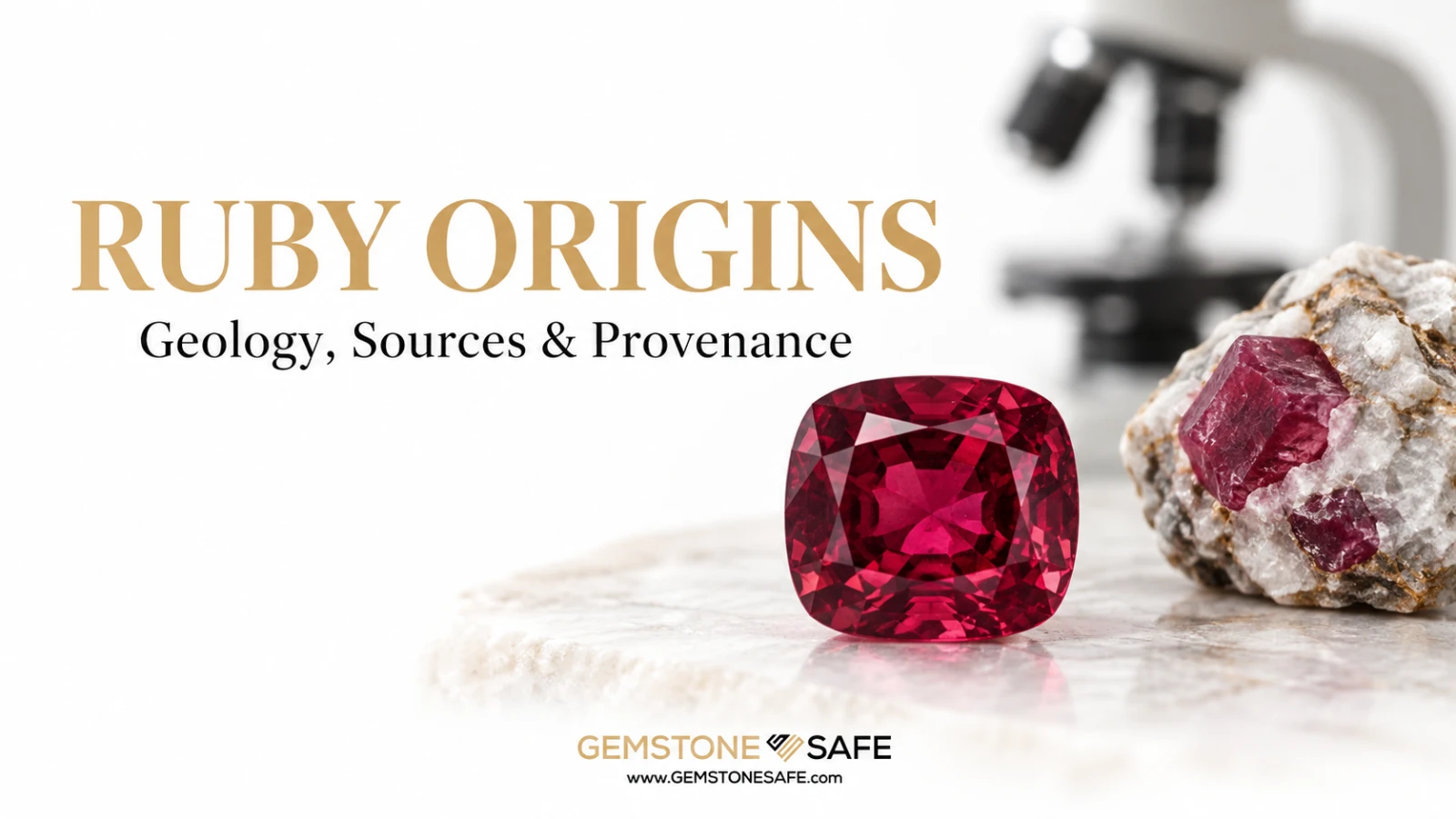
A ruby’s origin can mean several things: the geological environment in which its crystal grew, the country where it was recovered, or its documented journey through mining, cutting, and ownership. These questions are connected, but each requires different evidence. For someone choosing a ruby, the distinction has practical consequences. A seller’s reference to a celebrated locality should lead to a discussion about supporting documentation. A geological explanation should help readers understand the gemstone without promising that every stone from the same region will look alike. This final article in the GEMSTONESAFE Ruby Series explores formation, significant sources, and the evidence behind provenance. It also explains how to keep an origin claim in proportion when assessing an individual gem.
How Ruby Forms: The Right Chemistry in the Right Environment
Ruby is the red variety of corundum, aluminum oxide, with the formula Al₂O₃. Chromium is its principal red color-producing element. Iron also influences appearance: it can reduce the red fluorescence that contributes to the glowing appearance of some rubies. Consequently, two stones with similar body color can respond differently to light. Corundum crystallizes in the trigonal system. Ruby formation requires suitable aluminum availability, chromium, and a chemical environment sufficiently depleted in silica for corundum to develop. Where silica is available, aluminum may instead enter silicate minerals.
Many ruby deposits result from metamorphism the transformation of existing rocks under heat and pressure and associated fluid–rock reactions. In marble deposits, impurities within the original carbonate rocks and circulating fluids contribute to the chemistry needed for crystal growth. Other deposits involve metamorphosed mafic and ultramafic rocks, which are relatively rich in magnesium and iron. There is no single temperature, depth, or formation age applicable to every ruby. Deposit-specific geology matters; a simple claim that all rubies formed under identical conditions would hide the processes that make their origins interesting.
From Host Rock to Gem Gravel
A ruby’s place of recovery may differ from its original site of crystallization. Weathering breaks down the surrounding rock, releasing resistant crystals. Material can remain near its source, move downslope, or enter streams and rivers. Geologists distinguish these secondary concentrations by their history. Eluvial material develops through weathering near the source; colluvial material accumulates through downslope movement; alluvial deposits involve transport and deposition by flowing water. Finding ruby in river gravel therefore describes its recovery setting, rather than implying that the river formed the crystal.
Basalt associations require similar care. Some rubies are carried upward by magma as pre-existing crystals, called xenocrysts. Their presence in volcanic material does not automatically mean they crystallized from that transporting magma. These distinctions separate crystal formation from the later processes that bring gems within reach of miners.
Major Ruby Sources: A Geological Map, Not a Quality Ranking
Myanmar’s Mogok region has a centuries-long reputation for fine ruby. Vietnam’s Luc Yen and Quy Chau districts are also significant sources. Mozambique’s Montepuez deposits have become important to the modern trade, while the Thailand–Cambodia border region played a major supply role during the late twentieth century. Additional producing countries include Madagascar, Tanzania, Kenya, Afghanistan, Tajikistan, Pakistan, and Sri Lanka. These names are best treated as geographic context. A country can contain different deposits, and a deposit can produce material across a broad range of appearances. When comparing individual stones, avoid turning a country list into a hierarchy of beauty.
Two broad groupings help explain laboratory research. Marble-hosted rubies, including material from Myanmar and Vietnam, generally have low iron concentrations. A second, broadly defined high-iron group includes rubies from Mozambique, Madagascar, and Thailand–Cambodia. This laboratory grouping is useful, but it does not imply that every high-iron ruby formed through the same geological process. For readers, the useful follow-up is specific: does the description refer to a country, a district, a mine, or merely a color associated with a famous source? Ask the seller to identify exactly which claim is supported. A report naming a country should not be expanded into a more precise mine claim without additional evidence.
What the Interior of a Ruby Can Reveal
Inclusions are materials or features enclosed within a gemstone. Viewed under magnification, they can help reconstruct aspects of its growth and subsequent history. GIA’s ruby research describes combinations such as nested rutile needles in Mogok material, tourmaline inclusions in some Tajik rubies, and zircon clusters in some Madagascar specimens. None should be turned into a universal photograph-based identification rule. Similar features can occur in different sources, and a particular stone may lack the features most associated with its locality.
The distinction between an educational image and a laboratory conclusion matters here. A published inclusion photograph illustrates one observation in a studied specimen. It does not allow a reader to assign the same origin to every ruby containing a visually similar speck, needle, or fracture. For GEMSTONESAFE readers, inclusion images should encourage informed questions. If an origin claim is commercially significant, request the relevant report rather than relying on resemblance to an online reference image.
How Laboratories Assess Geographic Origin
Laboratories combine observations rather than relying on a single instrument. Microscopy examines growth features, enclosed minerals, and internal structures. Raman spectroscopy can identify many solid inclusions by their characteristic spectra. Ultraviolet, visible, and infrared spectroscopy can contribute information about a gemstone’s chemistry, formation, or treatment history.
Trace-element analysis provides another line of evidence. Laser ablation inductively coupled plasma mass spectrometry, usually shortened to LA-ICP-MS, measures very small elemental concentrations by removing a minute amount of material with a laser. Results are interpreted against reference samples of known origin. The technique is microdestructive, and its use depends on the laboratory’s procedures and the case under examination.
These methods address related but distinct questions. Evidence useful for identifying treatment may also influence how origin evidence is interpreted; it should not be assumed that one test independently resolves both. Before commissioning a report, clarify the purpose. GIA distinguishes an identification report, which describes the material and detectable treatments, from an identification and origin report that adds geographic origin. Ruby is eligible for its origin reporting service.
Why an Origin Opinion May Be Inconclusive
Laboratory instruments measure properties; specialists interpret what those properties support. SSEF explains that geographic origin is an expert opinion grounded in the available evidence and knowledge. It requires the combined interpretation of microscopic, chemical, spectroscopic, and geological information. Some rubies lack sufficiently distinctive evidence. Others share characteristics with reference material from more than one source. GIA documents cases where an inconclusive result is the appropriate outcome even after detailed examination.
For a buyer, an inconclusive origin should prompt a narrower description of what is known. Ask for the identification and treatment findings separately, and assess the gemstone on those findings and its visible qualities. Do not replace an inconclusive laboratory opinion with a confident seller story simply because the story is more appealing. If reports differ, ask for the discrepancy to be addressed openly. Keep the full documents together, including their dates and comments, so the uncertainty remains visible during any later discussion or sale.
Geographic Origin and Documented Provenance
A geographic opinion and a documented supply history answer different questions. Provenance records may connect a gemstone to earlier ownership, a rough sale, cutting, or other recorded stages. The strength of that account depends on how reliably the documents identify the same stone throughout. SSEF’s GemTrack service illustrates one specific approach: comparing a gemstone before and after cutting using scientific features. SSEF explicitly states that this service does not itself establish a mine of origin or how and when a gemstone was mined. Supporting commercial documentation has a separate role.
When reviewing a provenance claim, ask which stages are documented and which remain unknown. A useful file might contain laboratory reports, dated invoices, rough and polished photographs, and cutting records where available. Check that the evidence connects to the actual gemstone rather than merely to a parcel or supplier. Apply the same precision to responsible-sourcing claims. Ask what supporting records or independent assessment the seller can provide. A country name alone should not be treated as proof of working conditions, environmental practice, or a complete chain of custody.
How Origin Fits into Ruby’s Value
GIA identifies color as the leading ruby quality factor and explains the importance of clarity, cutting, and size. It also cautions against assuming that all stones from a famous source are fine quality: attractive rubies occur in multiple localities. For a practical comparison, place origin alongside the other information. Compare stones under consistent lighting and consider their appearance, treatment findings, dimensions, condition, and documentation before deciding what an origin claim means to you.
Avoid applying a fixed percentage premium to a country name. This article provides no such formula. A meaningful comparison would require closely comparable stones and a clearly defined transaction context; an isolated asking price would not establish a general rule. Likewise, a historic reputation should not become a promise of future appreciation or easy resale. Decide whether the origin matters for your collecting interest, personal connection, or purchasing brief, and make that preference explicit. This keeps the conversation focused on the gemstone and the evidence available for it.
Choose a Ruby with a Clear Understanding of Its Story
Before accepting a ruby’s origin description, ask three questions: What exactly is being claimed? Which document supports that claim? What remains uncertain? Keep those answers with the gemstone’s records. They help preserve a more accurate account for future owners and make later conversations about the stone easier to navigate.
If you have a preferred ruby origin or would like to discuss sourcing requirements and supporting documentation, reach ou to GEMSTONESAFE. Share the appearance you enjoy, your intended use, and the provenance information that matters to you, so those priorities can guide the discussion.