Ruby has long been regarded as one of the world’s most coveted colored gemstones. Its intense red appearance, rarity, durability, and remarkable geological history have made it a favorite among collectors, connoisseurs, and fine-jewelry buyers.
But what actually makes one ruby worth significantly more than another?
The answer begins with color but it does not end there. Ruby value is determined by a combination of color, clarity, cut, carat weight, treatment, and, in certain cases, geographic origin. Among these factors, color is generally the most significant.
The Science Behind Ruby’s Red Color
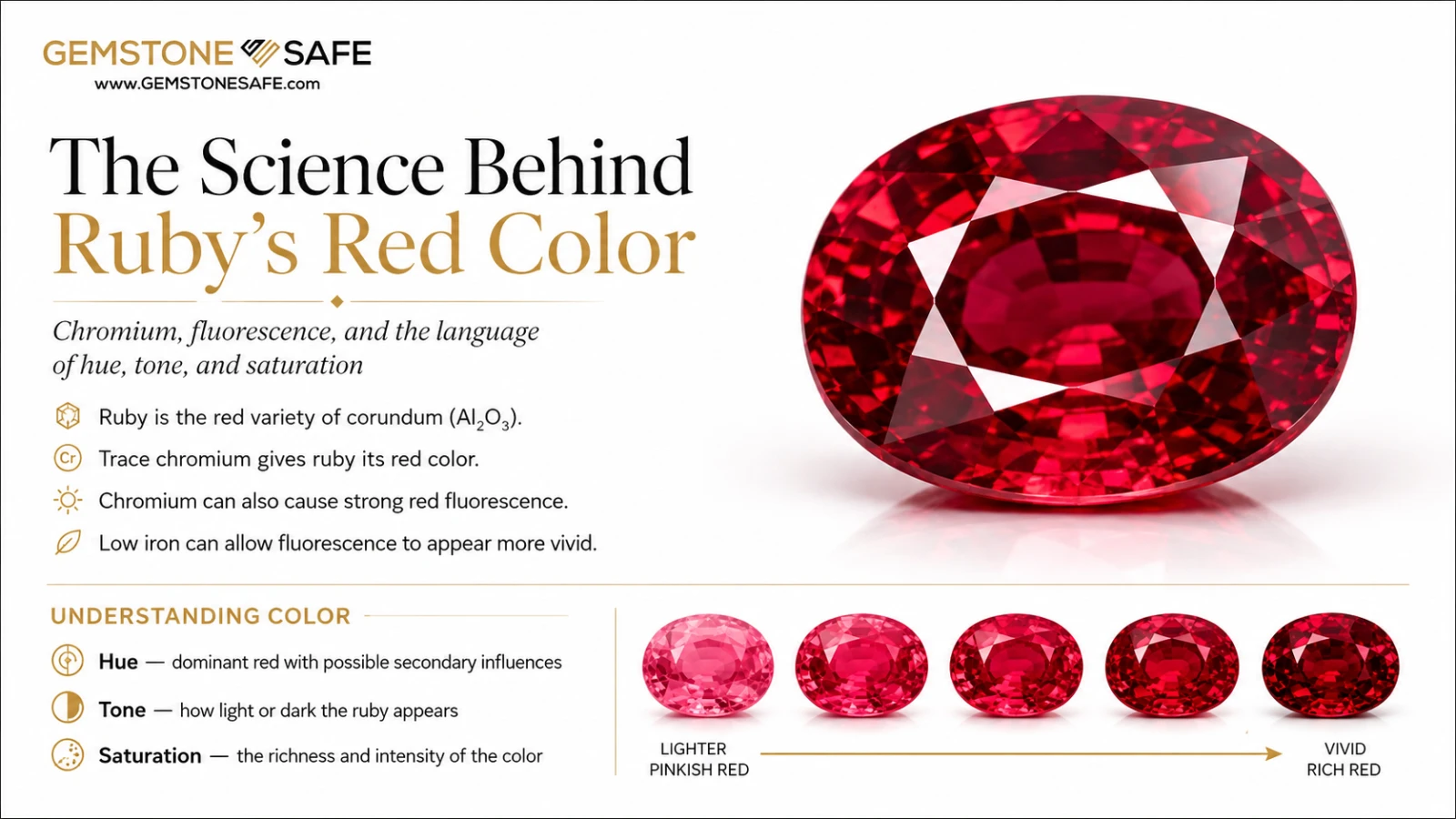
Ruby is the red variety of the mineral corundum, with a chemical composition of aluminum oxide (Al₂O₃). In pure form, corundum is colorless. Ruby develops its characteristic red color primarily because of trace amounts of chromium incorporated into its crystal structure.
Chromium does more than create red. It can also produce the striking red fluorescence for which many fine rubies are known. In low-iron, marble-hosted rubies, particularly those from certain deposits in Myanmar, this fluorescence can contribute to a vivid visual glow. This is one reason ruby is such a fascinating gemstone: its beauty is directly connected to its chemistry and geological environment.
Understanding Ruby Color: Hue, Tone and Saturation
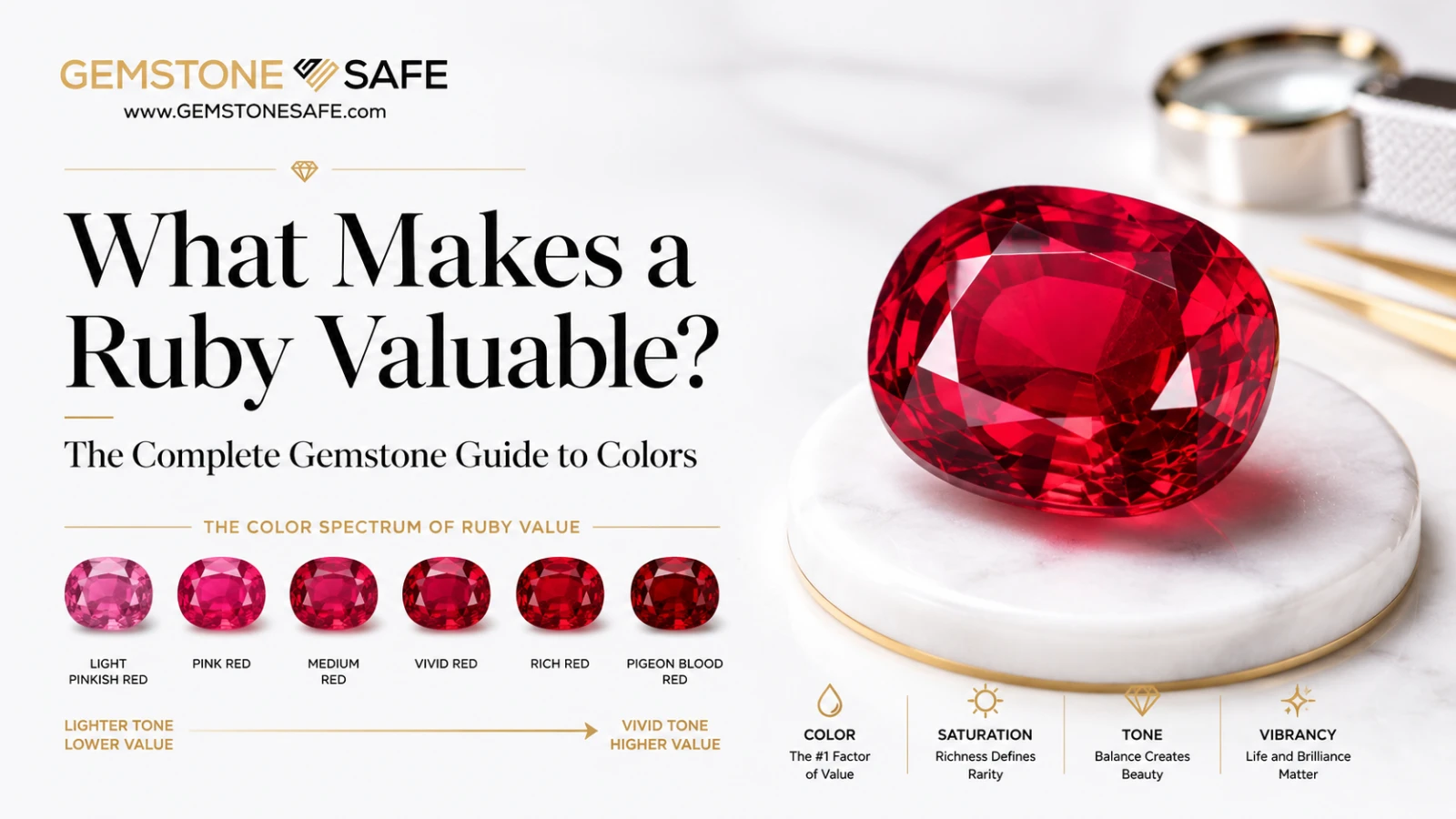
When evaluating ruby, simply calling a stone “red” is not enough. Professional color assessment considers several dimensions.
Hue
Hue describes the dominant color and any secondary color influences. Rubies can range from orangy red to purplish red, although the finest examples are generally associated with a pure, vibrant red to slightly purplish red appearance.
Tone
Tone refers to how light or dark the ruby appears. A ruby that is too light may lack the visual strength expected of fine ruby, while an excessively dark stone can lose brightness and liveliness.
Saturation
Saturation describes the strength or richness of the color. Fine rubies generally display strong, vivid saturation rather than a weak or washed-out appearance. The ideal combination of hue, tone, and saturation is therefore what creates the visual character that makes an exceptional ruby stand apart.
Why “Pigeon Blood” Ruby Gets So Much Attention
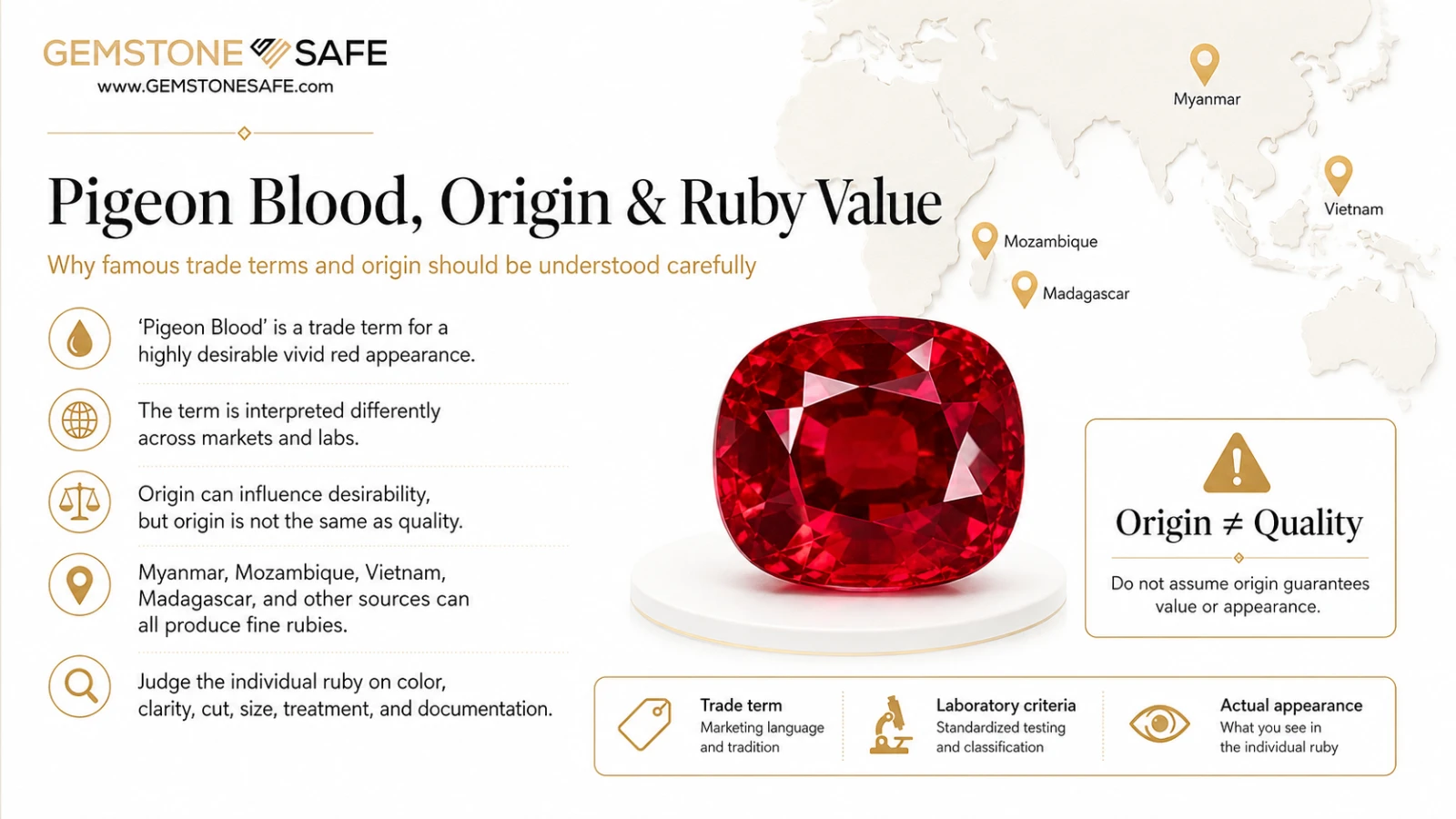
Few terms in the ruby trade are as famous as “pigeon blood.” The expression has traditionally been associated with particularly desirable red ruby colors, often describing a vivid red appearance with a soft, glowing quality. However, it is important to understand that trade terminology can be interpreted differently across markets and should not automatically be treated as a guarantee of quality or origin. A ruby's country of origin does not, by itself, make it a “pigeon blood ruby". The actual color and the criteria used by the evaluating laboratory matter. For serious purchases, buyers should therefore look beyond marketing terminology and examine the gemstone's documented characteristics.
Does Ruby Origin Affect Its Value?
Origin can influence the desirability and market value of ruby, but origin should never be confused with quality. Myanmar, particularly the historic Mogok region, has produced some of the world's most celebrated rubies. Other important sources include Ruby from Mozambique, from Vietnam, from Madagascar, Ruby from Afghanistan, Tanzania, and others. A famous origin does not mean every ruby from that locality is exceptional. Likewise, newer sources can produce rubies of extraordinary color and quality. GIA specifically advises buyers not to confuse origin with quality. For valuable stones, a laboratory origin opinion can therefore be an important part of the documentation but the individual gemstone must still be judged on its own merits.
Clarity: Are Inclusions Bad for Ruby?
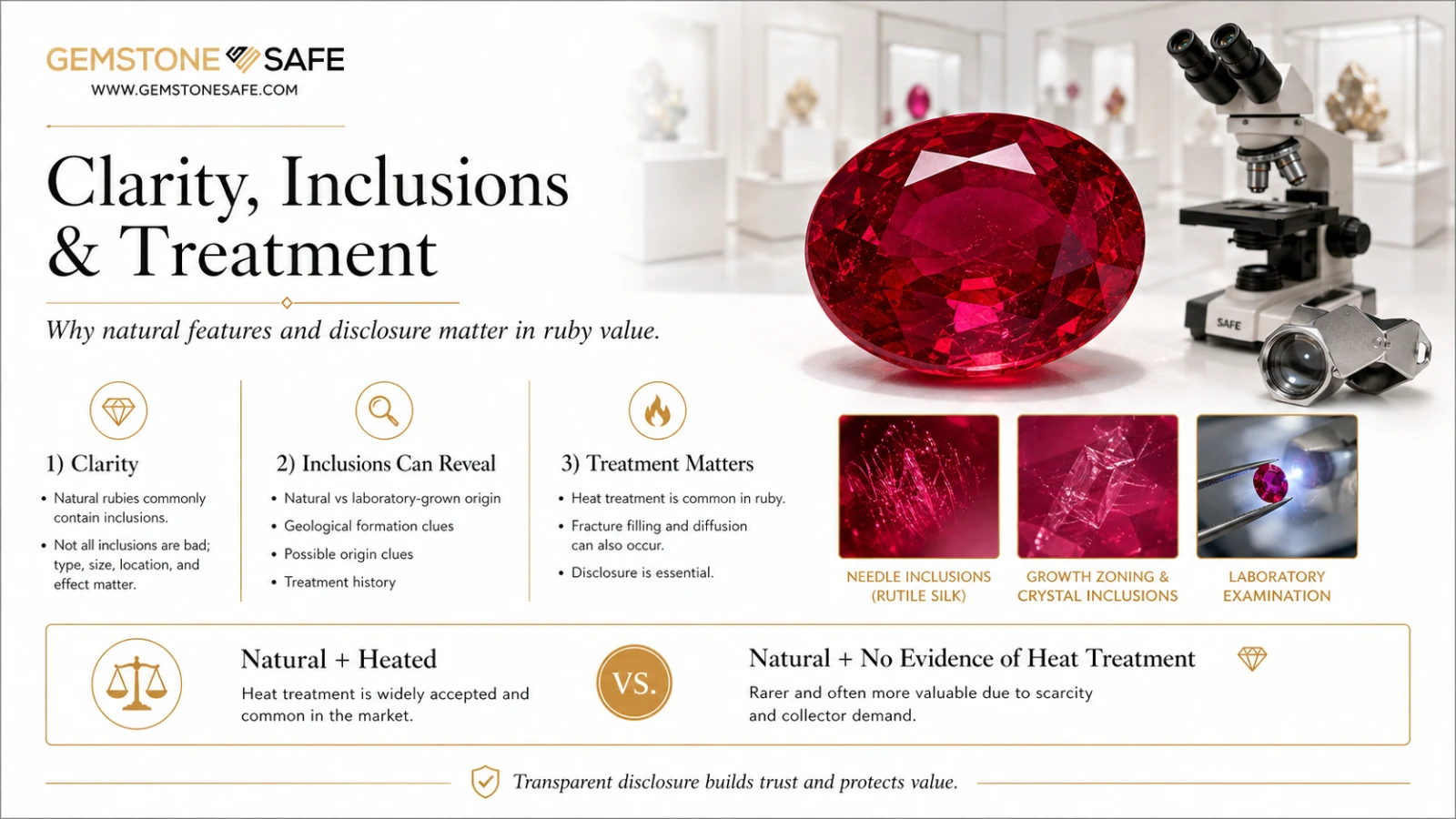
Unlike diamonds, natural rubies are rarely completely free of inclusions. Microscopic inclusions are common in natural ruby and can provide valuable information about the gemstone's formation and history. However, inclusions that significantly reduce transparency or brilliance can negatively affect value. For collectors and gemologists, inclusions can be particularly interesting because they may provide clues concerning:
- Natural versus laboratory-grown origin
- Geological formation
- Possible geographic origin
- Treatment history
This is why a ruby should never be judged simply by asking whether it is “clean.” The type, size, location, and effect of inclusions all matter.
Treatment: One of the Most Important Questions to Ask
Treatment can have a major impact on a ruby's value. Heat treatment is common in the ruby market and may be used to improve color or clarity. Other treatments, including fracture filling and diffusion, can also occur. For buyers, the key issue is disclosure. There is a major difference between:
Natural + Heated and Natural + No Evidence of Heat Treatment
Fine-quality rubies with independent laboratory confirmation that no evidence of heat treatment is present can command a premium because of their rarity. This is why the word “natural” alone is not enough. A natural ruby can still have been treated.
Size and Cut Matter Too
Color may lead the value equation, but size and cutting also play important roles. Fine-quality rubies above one carat are particularly rare, and per-carat prices can increase substantially as size increases. Cut determines how effectively the gemstone interacts with light and how its color appears face-up. A well-considered cut can enhance brilliance and visual appeal, oval shape ruby has it's own uniqueness while poor cutting can diminish the beauty of even excellent rough material.
So, What Makes a Ruby Truly Valuable?
There is no single characteristic that determines the value of every ruby. The most desirable stones bring together several qualities:
Exceptional color: vivid, attractive red with balanced tone and saturation.
Strong visual appeal: good brightness and pleasing appearance.
Good clarity: inclusions that do not significantly compromise transparency or bril
liance.
Quality cutting: proportions and faceting that showcase the stone's natural beauty.
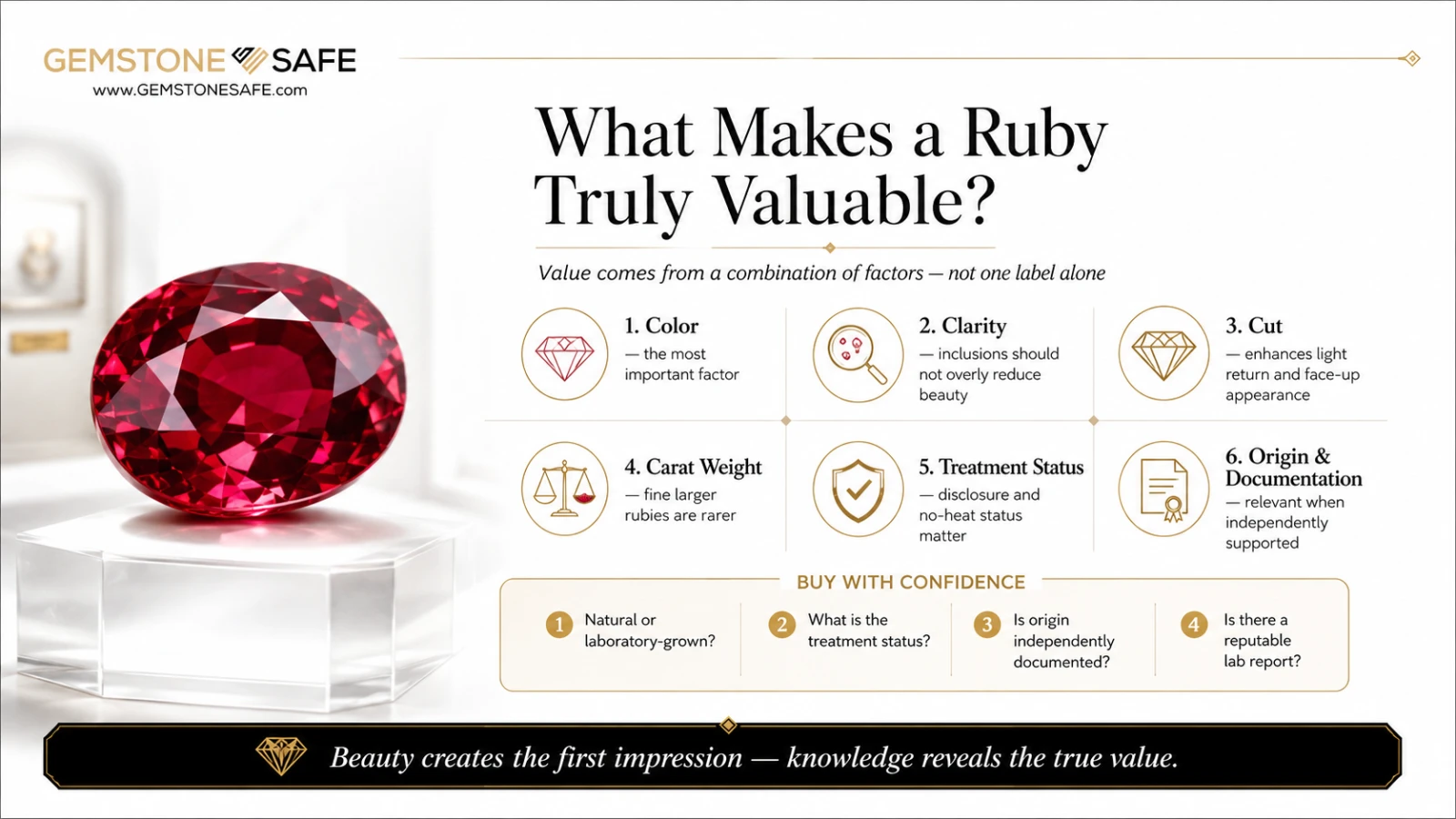
Significant size: particularly when combined with fine quality.
Desirable treatment status: especially independent confirmation of no detectable heat treatment in exceptional stones.
Documented origin: where an origin determination is possible and commercially relevant.
Ultimately, the value of ruby lies in the combination of these characteristics rather than in a single label or marketing term.
Buying Ruby with Confidence
When purchasing a significant ruby, ask more than just its price and carat weight.
Ask:
- Is the ruby natural or laboratory-grown?
- What is its treatment status?
- How strong and attractive is its color?
- Are the inclusions affecting transparency?
- Is the claimed origin independently documented?
- Does the gemstone have a reputable laboratory report?
- Does the report correspond to the actual stone?
For important purchases, independent laboratory documentation can provide valuable information about identity, treatment and, where possible, geographic origin.
The GEMSTONESAFE Perspective
A beautiful ruby is more than a red gemstone. Its color tells a story of chemistry, its inclusions preserve clues about geological formation, and its treatment history can influence rarity and value.
The most important lesson for any ruby buyer is simple: don't judge the stone by color alone.
Look deeper. Understand its chemistry, color, inclusions, treatment, origin and documentation. Because when it comes to exceptional ruby, beauty creates the first impression but knowledge reveals the true value.
| Buy Safe, Buy Smart, Buy Verified with GEMSTONESAFE. |