A ruby can mark a July birthday, celebrate a marriage, or preserve the memory of someone who wore it before us. Its significance can be deeply personal even when two stones share the same mineral identity. Understanding ruby’s meaning therefore involves more than collecting a list of supposed powers: it means asking who gave the gemstone those meanings, in which tradition, and for what purpose.
This article explores ruby as a birthstone, a historical jewel, and a symbol in spiritual traditions. These perspectives can enrich our appreciation without turning cultural beliefs into scientific claims. A gemstone does not need to promise extraordinary effects to carry an extraordinary story.
Ruby as July’s Birthstone
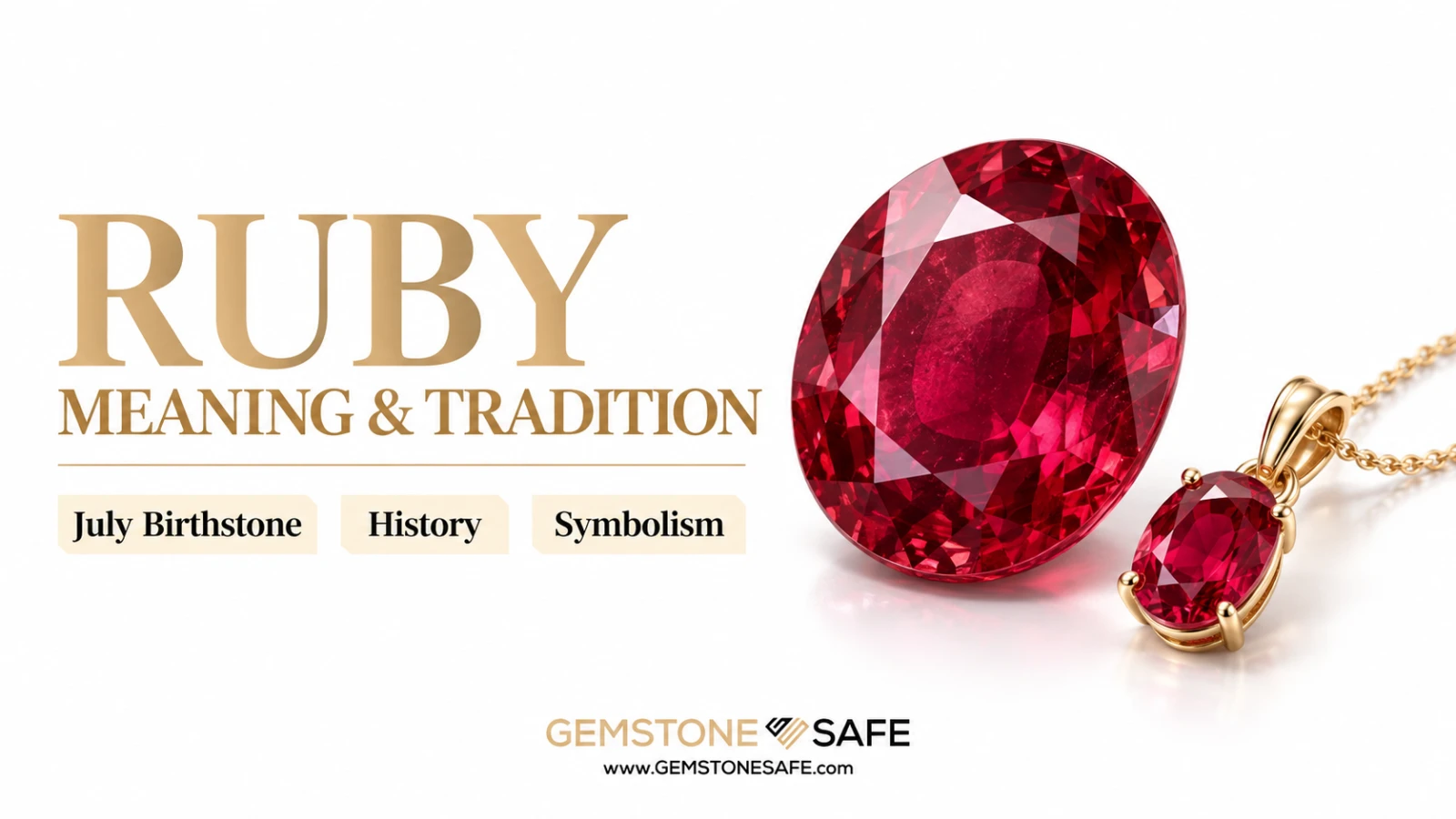
Ruby is recognized as July’s birthstone in the contemporary birthstone convention presented by the Gemological Institute of America. GIA also identifies it as a traditional gemstone gift for the fifteenth and fortieth wedding anniversaries. These associations offer familiar starting points for selecting meaningful jewelry. A July ruby can represent the wearer’s own birthday or someone else’s: a parent might choose it to commemorate a child, while a partner might include a small ruby in a piece celebrating a shared life. Its significance comes from the relationship attached to the date.
For a fortieth anniversary, the gemstone can express continuity and affection. That interpretation need not depend on an elaborate spiritual explanation. A note recalling a particular memory may make the gift more personal than a generic declaration about what ruby supposedly brings to every wearer. The distinction between a birthstone and an astrological prescription is also important. A monthly birthstone association identifies a commemorative convention; it does not establish that everyone born that month needs the stone or will benefit from wearing it. People born in other months can choose ruby simply because they love it.
Why Red Became Central to Ruby’s Meaning
GIA traces the name ruby to the Latin ruber, meaning red, and describes historical associations between its color, blood, life, and intense emotion. It also records the Sanskrit name ratnaraj, commonly translated as “king of precious stones.” These names reveal the admiration attached to the gem. The color offers an understandable starting point for interpretation. A viewer may see warmth, energy, or romance in a ruby, while another may associate the same red with determination or ceremony. These are responses to appearance and context, rather than properties that can be measured with a gemological instrument.
For modern jewelry, this leaves room for individual expression. A ruby chosen to celebrate a professional achievement can stand for perseverance. One inherited from a grandmother may represent family continuity. Neither owner needs to surrender that meaning to a universal symbolism chart. When describing a particular piece, the most convincing explanation is often specific: who chose it, what occasion it marked, and why the color appealed to them.
Ruby in Indian Gem Traditions
One of the clearest documented examples of ruby symbolism is the Indian navaratna, or nine-gem, tradition. The Metropolitan Museum of Art explains that these jewels bring together gemstones associated with celestial powers; ruby represents the Sun and occupies the central position in the traditional arrangement. This is a cosmological relationship expressed through jewelry. The arrangement matters as much as the individual stones. A navaratna jewel is not simply a colorful selection of valuable materials. Its organization communicates a framework of belief, giving placement and combination a significance beyond decoration.
A surviving pendant in the Philadelphia Museum of Art illustrates how objects can change over time. The museum explains that a ruby probably once occupied its center, but was replaced by an emerald bearing a Persian inscription. The qualification “probably” matters: a museum interpretation can be well informed while still acknowledging uncertainty about an object’s earlier state. These examples invite careful appreciation. Ruby’s solar association belongs to an identifiable tradition, not a universal rule shared by every culture. The belief that a jewel could embody cosmic harmony should be understood within that tradition rather than presented as proof that gemstones control events.
Protective Legends and European Jewelry
GIA’s account of ruby lore records beliefs in protection among Burmese warriors and associations with health, wisdom, wealth, and success in love in medieval Europe. These are accounts of what people believed, not evidence that the gemstone delivered those outcomes. The wider history of jewelry helps explain the setting for such ideas. The Victoria and Albert Museum describes medieval European jewelry as an expression of social hierarchy, with precious materials worn by royalty and nobility. Protective powers and inscriptions also formed part of how jewels were understood.
In that setting, adornment could communicate status and express hope at the same time. A jewel might be admired for its color while being valued as a protective object. Understanding those overlapping roles is more informative than reducing every historical ruby to a modern promise of “good luck.” It is equally important not to treat a broad historical summary as the belief of every individual. Period, place, religious practice, and the purpose of the object all affect interpretation. A court jewel, a devotional ornament, and a personal gift need not tell the same story.
When a Famous “Ruby” Is Actually Spinel
Historical gemstone names do not always match modern mineral classification. GIA identifies the Black Prince’s Ruby and the Timur Ruby as spinels, despite their familiar names. Red spinels were historically known as “balas rubies,” and their resemblance to ruby contributed to longstanding confusion. This distinction changes how we read jewel histories. A stone called ruby in an old description cannot automatically be counted as red corundum. Its modern identification, when available, should guide the mineralogical statement, while the traditional name can remain part of its cultural identity.
The correction does not diminish the object’s historical importance. It makes the story more accurate. A celebrated spinel remains a remarkable jewel; it does not need to be ruby to deserve attention. For readers, this is a useful habit: separate the object’s name, its documented ownership, its legends, and its mineral identity. Each answers a different question, and evidence for one does not automatically establish the others.
Modern Metaphysical Associations: What Is Being Claimed?
Contemporary crystal literature often gives ruby an energetic vocabulary. For example, the commercial crystal guide Crystal Vaults associates it with vitality, confidence, passion, and the base or root chakra. This is an example of modern metaphysical interpretation, not a gemological or medical authority. Someone drawn to those associations may choose ruby as a reminder to act courageously or pursue a valued goal. That is a personal symbolic use. It differs from asserting that the mineral itself changes a person’s energy, personality, or physical condition.
Modern lists should also be kept distinct from documented historical traditions. A present-day chakra association does not, by itself, establish how a medieval European owner understood a jewel. Likewise, the solar role of ruby in navaratna jewelry should not be silently merged with every contemporary spiritual description. A useful way to read such material is to ask whether the author is reporting a historical source, describing a present-day practice, or making a claim about a measurable effect. The first two can be discussed as cultural information. The third requires scientific evidence.
Ruby Healing Properties: Belief and Evidence
Historical and modern claims about “ruby healing properties” belong in an account of belief, not a list of established health benefits. Wearing ruby has no established medical role in treating illness. Its symbolic connection with life or vitality does not demonstrate an effect on the body.
Research on crystal healing illustrates why this distinction matters. A randomized study published in 2025 assigned 138 adults to rose quartz or a visually matched placebo for a fourteen-day protocol. It found no difference between the groups in the primary anxiety outcomes; improvements were associated with belief rather than receiving the genuine crystal. This was not a ruby study, so it should not be represented as a direct test of ruby.
The practical distinction is straightforward: finding comfort in a meaningful possession does not establish a gemstone-specific treatment effect. Ruby can be appreciated as jewelry, a keepsake, or a personal symbol without being used as a substitute for appropriate healthcare.
Choosing a Ruby Gift with a Story Worth Keeping
Begin with the recipient rather than a list of promised powers. Would a July birthstone connection feel meaningful? Is the gift celebrating a relationship, honoring a family member, or marking a personal achievement? The answer can guide both the design and the message accompanying it.
Consider a few ways to make the meaning explicit:
· Include a short note explaining the occasion and why you chose ruby.
· Record the date and the names of the people connected with the gift.
· If the piece is inherited, preserve the known family story and identify uncertain details as recollections.
· When drawing on a cultural tradition, name it accurately rather than describing the symbolism as universal.
You might write that a ruby represents the courage someone showed during a difficult year. That expresses your intention without claiming the gemstone produces courage. Similarly, a romantic gift can symbolize commitment without promising to secure a relationship. Keep the factual description with the personal story. Whether a stone is natural or laboratory-grown, and how it has been treated, should be described honestly. Sentimental meaning does not require an exaggerated claim about rarity or an invented provenance.
A Personal Meaning, Informed by History
Ruby’s cultural appeal allows several ways of relating to the same gem: a birthstone tradition, a historical interest, a spiritual association, or a private memory. Understanding the source of each interpretation lets you choose what resonates while respecting the traditions behind it. The most enduring meaning may be the one you can explain in your own words. A ruby can accompany a story of affection, achievement, or remembrance because you deliberately chose it to do so.
Explore ruby with GEMSTONESAFE for its beauty, history, and personal significance. Contact us to discuss a birthstone gift, an anniversary idea, or a gemstone that reflects a meaningful occasion in your life.